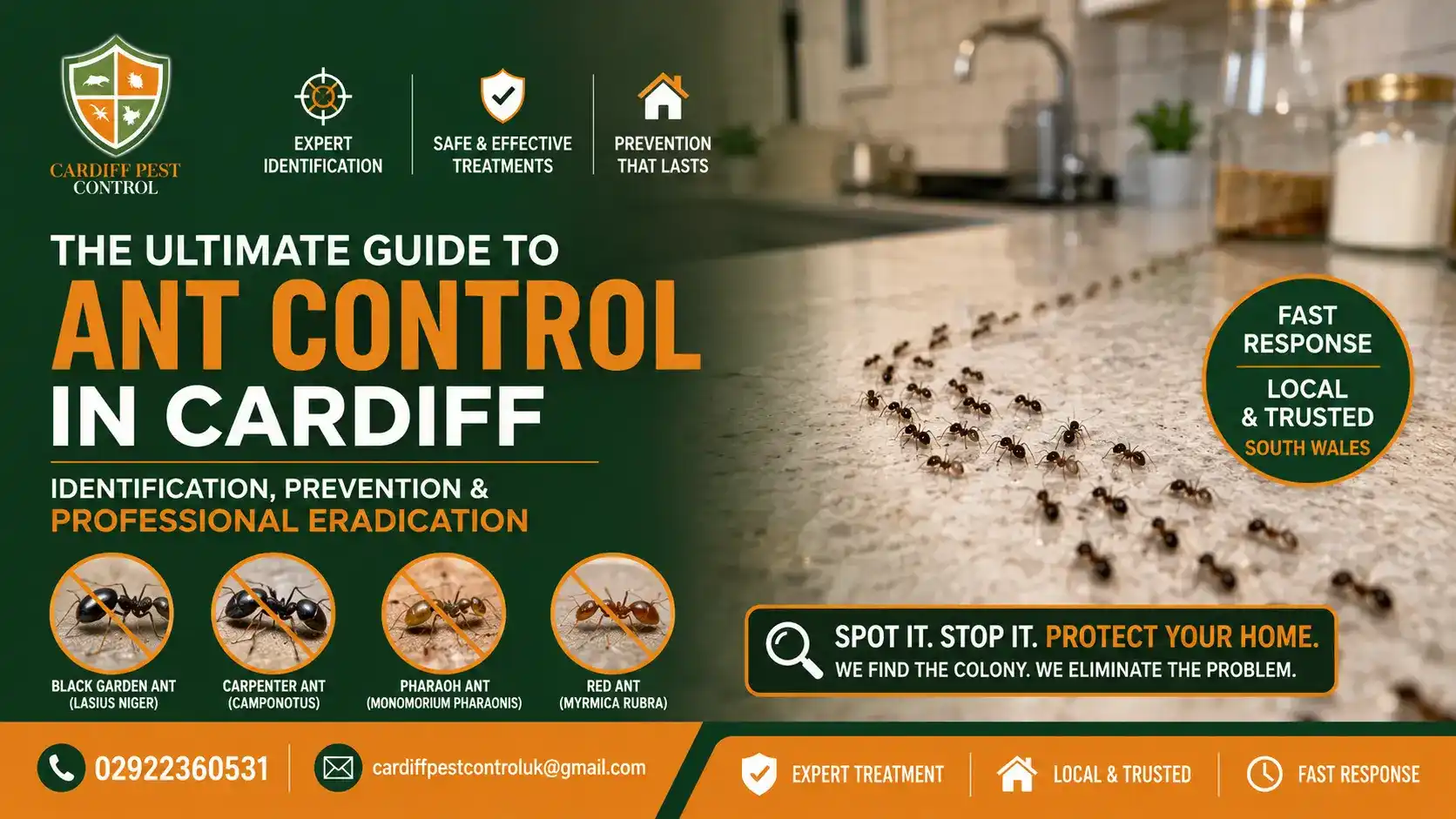
An ant invasion is far more than a minor inconvenience. Whether you are dealing with a trail of black garden ants marching across your kitchen worktop or the more serious structural threat posed by carpenter ants excavating your floor joists, these highly organised social insects are remarkably resilient and notoriously difficult to eliminate without the right approach.
At Cardiff Pest Control, we respond to ant infestations across Cardiff, the Vale of Glamorgan, Caerphilly, and all surrounding South Wales communities every single week, particularly during the peak summer months when ant activity surges. However, centrally heated modern homes can provide a year-round sanctuary for certain species, meaning ant problems are no longer seasonal for many Cardiff residents.
In this comprehensive guide, we cover everything you need to know: species identification, dietary behaviour, why DIY methods so frequently fail, and the most effective professional strategies for how to get rid of ants in the house for good.
Termites vs Ants: Are You Identifying the Right Pest?
Before any treatment can begin, it is essential to confirm you are dealing with ants and not another timber-destroying pest. We regularly receive urgent calls from Cardiff homeowners convinced they have a termite problem, when in fact they are observing flying ants during the annual nuptial flight.
While both can appear in large numbers and potentially damage timber, their biological profiles are entirely distinct.
Key Physical Differences at a Glance
Body shape: Ants have a highly distinctive, pinched waist (called the petiole) between the thorax and abdomen. Termites have a broad, straight, uniform body with no visible waist.
Antennae: Ant antennae are elbowed, bent at a sharp angle, like a bent arm. Termite antennae are straight and beaded in appearance, resembling a string of tiny pearls.
Wings (on swarmers): Flying ants have two pairs of wings of noticeably unequal size — the front pair is substantially larger than the rear pair. Termite swarmers have four wings of equal length, typically twice the length of their body, which they shed after mating.
Colour: UK garden ants are typically dark brown to black. Termites are usually pale, cream, or translucent.
If you have any concerns about wood-boring pest damage to your property, our dedicated guide on how to get rid of termites at home provides a detailed comparison and action plan.
Types of Ants Commonly Found in Cardiff Homes
Effective ant control begins with accurate species identification. Different ant species have different nesting preferences, dietary needs, and, critically, different responses to treatment. Using the wrong approach for the wrong species can make an infestation significantly worse.
1. Black Garden Ants (Lasius niger)
The most common ant species encountered by our Cardiff pest control team, black garden ants are dark brown to black and measure between 3mm and 5mm in length. They are also frequently called sugar ants due to their strong preference for sweet, carbohydrate-rich food sources.
They typically nest outdoors in garden soil, beneath paving slabs, alongside driveways, and under the foundations of garden walls, but enter homes through hairline cracks and gaps around window frames and door sills in search of food. While black garden ants do not carry diseases, their foraging trails across kitchen surfaces are unhygienic, and their numbers can grow rapidly in summer.
2. Carpenter Ants (Camponotus species)
If you are specifically searching for how to get rid of carpenter ants, you are dealing with a considerably more serious threat than garden ants. Carpenter ants do not eat wood; rather, they excavate it, carving out galleries and chambers to house their expanding colony. They are significantly larger than garden ants (up to 12mm in length) and are particularly attracted to damp, softened, or decaying timber.
Left untreated, a mature carpenter ant infestation can compromise the structural integrity of roof timbers, floor joists, window frames, and door surrounds. This makes early detection absolutely critical.
3. Pharaoh Ants (Monomorium pharaonis)
Pharaoh ants are among the most challenging ant species to eradicate and a significant concern in multi-occupancy buildings, hospitals, care homes, restaurant kitchens, and heated residential flats in Cardiff city centre. They are tiny, approximately 2mm long, with a pale yellow to light brown colouring that makes them difficult to spot on light-coloured surfaces.
What makes pharaoh ants uniquely dangerous is their budding behaviour: if a colony is disturbed by a repellent spray or aggressive treatment, it fragments into multiple new colonies, each establishing a new nest elsewhere in the building. A single mishandled pharaoh ant infestation can rapidly escalate from one colony to dozens. Professional baiting is the only viable treatment method for this species never use contact spray.
4. Red Ants / European Fire Ants (Myrmica rubra)
Reddish-brown in colour and approximately 4–5mm in length, red ants are well known for their painful sting, which can trigger allergic reactions in sensitive individuals. They typically nest outdoors in garden lawns, flower beds, and compost heaps, but will migrate indoors during extreme weather particularly during prolonged wet periods, which are a regular feature of the South Wales climate.
For a broader overview of the insects most commonly encountered in UK properties, read our guide on the 6 most common insects in UK homes.
What Do Ants Eat? Understanding the Foraging Cycle
To understand what kills ants effectively and why so many DIY products fail it helps to understand what ants actually need nutritionally.
An ant colony requires two primary food sources to function:
Carbohydrates (sugars): Primarily used to fuel the energetic foraging workers. This is why ants are drawn to spilt juice, honey, ripe fruit, jam, biscuit crumbs, and sweet drinks left out on worktops.
Proteins: Essential for the queen to produce eggs and for larvae to develop into adults. Protein sources include other insects, pet food, meat scraps, and certain cheese products.
Critically, a colony’s nutritional requirements shift throughout the year. In spring and early summer, protein demand is high as the colony is growing rapidly. In late summer and autumn, carbohydrate demand increases as the colony prepares for winter. This is why a bait product that worked effectively in spring may be ignored entirely by autumn. At Cardiff Pest Control, we use a rotation of protein-based and sugar-based professional baits to ensure foragers consistently carry treatment back to the heart of the nest regardless of the season.
How to Get Rid of Ants in the House: A Professional Step-by-Step Plan
When you first spot a foraging trail, the instinct is to reach for a spray. We strongly advise against this particularly before identifying the species. Here is the methodical approach our Cardiff ant control team follows.
Step 1: Sanitation and Source Elimination
Ants follow invisible pheromone trails, chemical signals left by scout ants that act as a GPS route for the rest of the foraging party. Killing the ants you can see without disrupting these trails simply means more ants will follow the same path within hours.
- Wipe all surfaces where ant activity has been observed with a solution of white vinegar and water. This effectively disrupts and neutralises pheromone trails.
- Transfer all dry goods flour, sugar, cereals, pasta, rice, oats, biscuits into airtight glass or hard plastic containers. Cardboard packaging is not a barrier for determined foragers.
- Do not leave pet food bowls out overnight. Both garden ants and pharaoh ants are strongly attracted to wet pet food.
- Empty kitchen bins regularly and ensure bin lids seal correctly.
Step 2: Identify and Seal Entry Points
Ants enter properties through extremely small gaps. A methodical inspection of your home’s exterior and interior junctions is worthwhile:
- Apply silicone caulk around window frames, door sills, and skirting board junctions
- Seal where utility pipes and cables enter the building
- Check for gaps in airbricks and replace damaged vent covers
- Inspect the pointing on external brickwork, particularly at ground level
For general advice on managing multiple pest entry points, our guide on how to control common household pests is a useful resource.
Step 3: Household Deterrents (Temporary Relief)
The following measures can reduce ant activity short-term but should not be relied upon as a sole control strategy:
- Talcum powder or chalk lines: Ants are reluctant to cross powdery substances as particles interfere with their sensory organs. Useful as a temporary barrier at known entry points.
- Boiling water: If a nest entrance is clearly visible in a garden patio or path, boiling water poured directly into the entrance can collapse upper galleries. However, it rarely reaches the queen and deeper chambers.
- Strong-smelling deterrents: Peppermint oil, cinnamon, and cloves can act as mild repellents, but they will not eliminate a colony and offer no lasting control.
Step 4: Professional Baiting — The Only Permanent Solution
Professional ant control baiting is the gold standard for colony elimination, and the approach our Cardiff pest control technicians use for all but the most minor infestations. Here is how it works:
Professional-grade non-repellent bait is strategically placed in areas of high foraging activity. Unlike contact sprays, non-repellent baits are completely undetectable to the ants; they neither attract nor deter, they are simply encountered naturally during foraging. The worker ants consume the bait and carry it back to the nest, where it is shared with larvae and the queen through a process called trophallaxis (the direct transfer of food between colony members).
The slow-acting toxin allows the bait to circulate through the entire colony before taking effect. The result is elimination from the inside out including the queen, without whose survival the colony cannot regenerate.
This process typically takes 1–2 weeks for complete colony elimination, which is often longer than homeowners expect, but far more permanent than any spray treatment.
For persistent or recurring ant problems in Cardiff kitchens specifically, read our dedicated guide on how to get rid of ants in the kitchen.
How to Get Rid of Carpenter Ants: A Specialist Approach
Carpenter ant infestations demand a fundamentally different treatment strategy from garden or pharaoh ant infestations. Because the colony is housed within the timber structure of your property, simply treating the ants you can see on surfaces has no meaningful impact on the nest.
Our Cardiff pest control team follows these steps for carpenter ant eradication:
Locate the parent colony: Carpenter ant satellite colonies inside your home are typically supplied by a much larger parent colony located outdoors — commonly in a tree stump, woodpile, decaying fence post, or old outbuilding. Eliminating the indoor satellite colony without addressing the outdoor parent colony guarantees re-infestation.
Address moisture at the source: Carpenter ants are strongly attracted to damp, softened timber. Leaking roof joints, poorly sealed window frames, plumbing leaks within walls, and inadequate subfloor ventilation all create the conditions carpenter ants exploit. Repairing these moisture sources is a prerequisite for successful long-term control.
Inspect accessible roof and loft spaces: Carpenter ant frass a mix of fine wood dust, insect fragments, and faecal matter, is often found beneath active galleries. If your loft or attic space contains significant debris that is obscuring a full structural inspection, our loft clearance service can prepare the space for a thorough pest assessment.
Professional residual treatment: Our technicians apply professional-grade residual insecticide directly into active gallery openings and suspected harbourage voids, combined with a perimeter treatment to intercept foraging workers returning to the nest.
Technical Data: Ant Biology and Colony Structure
Understanding the biology of the colony is essential to understanding why certain treatments work and others fail.
Worker ants: The foraging workers you observe on surfaces represent only approximately 5–10% of the total colony population at any given time. They live for a few months to around one year, depending on the species and season.
Male ants (drones): Males exist solely to mate with new queens during the nuptial (flying ant) swarm. They typically die within a few weeks of mating.
The queen: The queen is the only reproductively active female in the colony and is the single most critical target in any ant control programme. A queen ant can live for 15 to 30 years, depending on the species, meaning an untreated colony has effectively permanent residency in your property. She may produce thousands of replacement workers to replace every ant you spray.
This biological reality is precisely why contact spray treatments are largely ineffective against established colonies. Eliminating the queen is the only path to permanent eradication.
Why DIY Ant Control Methods Frequently Fail
The most common and costly mistake we observe Cardiff homeowners making is the repeated use of contact-kill insecticide sprays purchased from supermarkets or DIY retailers. Here is why these products so rarely solve the problem:
You are only targeting the foragers: The workers you can see represent a small fraction of the total colony. The remaining population, including the queen, larvae, and resting workers, remains safely harboured in the nest, entirely unaffected.
Pheromone trails persist: Killing the visible ants does not remove the chemical trail. New foragers follow the same route within hours.
Colony fragmentation in pharaoh ants: For pharaoh ant infestations specifically, contact sprays trigger a stress response that causes the colony to fragment and scatter rapidly converting one manageable infestation into multiple new colonies distributed throughout the property.
No residual protection: Supermarket sprays offer no lasting residual barrier. A new colony can establish along the same entry routes within days of treatment.
Our professional ant control service in Cardiff delivers:
- Accurate species identification before any treatment begins
- Strategic slow-acting bait placement targeting the queen and full colony
- Professional residual barrier application around the property perimeter
- Follow-up inspection to confirm colony elimination
- Advice on structural and hygiene modifications to prevent re-infestation
For a full overview of our Cardiff ant control service, visit our dedicated ant control service page.
Choosing the Best Ant Bait: What the Professionals Use
Not all ant baits are created equal. Our Cardiff pest control technicians select baits based on species identification, time of year, and the nutritional phase of the target colony. For a detailed breakdown of the most effective professional and retail bait options, read our comprehensive guide on the best ant baits available in the UK.
Get Professional Ant Control in Cardiff Today
If you have identified any of the signs or species described in this guide — or if your DIY efforts simply are not working- it is time to call in Cardiff Pest Control. A colony left untreated will not shrink on its own. With a queen capable of surviving for up to 30 years and producing thousands of new workers, an ignored ant problem becomes an entrenched one.
Cardiff Pest Control provides fast, professional, and discreet ant extermination services across Cardiff, Pontypridd, Barry, Penarth, Caerphilly, and all surrounding areas. Our technicians are fully trained in species identification and use professional-grade products and baiting systems not available to the public.
Frequently Asked Questions
1. Why do I have ants in my bathroom?
Ants are attracted to the persistent moisture in bathrooms. Pharaoh ants in particular are drawn to humid environments and may also be foraging on organic matter accumulating around waste pipes and drains. If you are also seeing small flies around the same drain area, our guide on how to get rid of drain flies may also be relevant.
2. Why do I suddenly have ants in my house when I never had them before?
A change in conditions, such as hot, dry weather driving ants to seek moisture indoors, a new food source becoming available, or nearby outdoor nests expanding, can trigger sudden indoor foraging. New building work or garden landscaping that disturbs existing nests also commonly pushes established colonies inside.
3. What is the fastest way to get rid of ants in the house?
For immediate visible reduction, thoroughly cleaning all surfaces with a vinegar solution to disrupt pheromone trails and removing all accessible food sources will reduce activity quickly. However, the only method that permanently eliminates the colony is professional slow-acting bait treatment targeting the queen.
4. Is it true that ants dislike cinnamon?
Cinnamon’s strong volatile oils act as a mild sensory deterrent for some ant species, but it will not kill ants or prevent a motivated colony from finding a route around it. It is not a reliable treatment for an established infestation.
5. Can ants damage my home’s electrical wiring?
Common UK garden ants very rarely cause electrical damage. However, certain invasive species, such as the red fire ant and the so-called “crazy ant” (Nylanderia fulva), not yet widespread in the UK but expanding in range, are attracted to electrical fields and have been documented causing short circuits in electrical equipment. If you suspect any pest activity near electrical installations, contact a professional immediately.
6. How do I know if I have carpenter ants nesting inside my walls?
The most reliable indicator is frass, a fine, powdery material that resembles sawdust, composed of wood particles and insect debris that carpenter ants push out of their tunnels. You may find this beneath skirting boards, around window frames, or on attic floor boards. You may also hear a faint, dry rustling or tapping sound from within the wall structure at night when the house is quiet.
7. Do ants bite humans, and is it dangerous?
Black garden ants can technically bite, but rarely do, and the bite is negligible. Red ants (Myrmica rubra) sting rather than bite, and their sting can be painful and cause localised swelling. In rare cases, individuals with insect venom allergies can experience a more serious reaction. For detailed information on ant bites and stings, read our guide on ant bite causes and symptoms.
8. Will ants go away on their own without treatment?
An established colony with access to reliable food and moisture sources will not relocate voluntarily. While foraging trails may shift seasonally, the colony itself will persist and continue to grow. Without intervention and particularly without eliminating the queen, an ant infestation becomes a permanent fixture.
9. How long does professional ant treatment take to work?
Professional slow-acting bait treatments typically show a marked reduction in foraging activity within 3–7 days, with full colony elimination usually confirmed within 1–3 weeks, depending on colony size and species. Carpenter ant infestations in structural timber may require a longer treatment programme and follow-up inspection.
10. When should I call Cardiff Pest Control for an ant problem?
Contact a professional if: you have identified the ants as pharaoh ants (small, pale, indoor), carpenter ants, or any species causing structural damage; if DIY products have failed to reduce activity after two weeks; if you are seeing ants year-round rather than seasonally; or if multiple rooms or floors of your property are affected. Cardiff Pest Control offers prompt inspections and same-week appointments across Cardiff and South Wales.