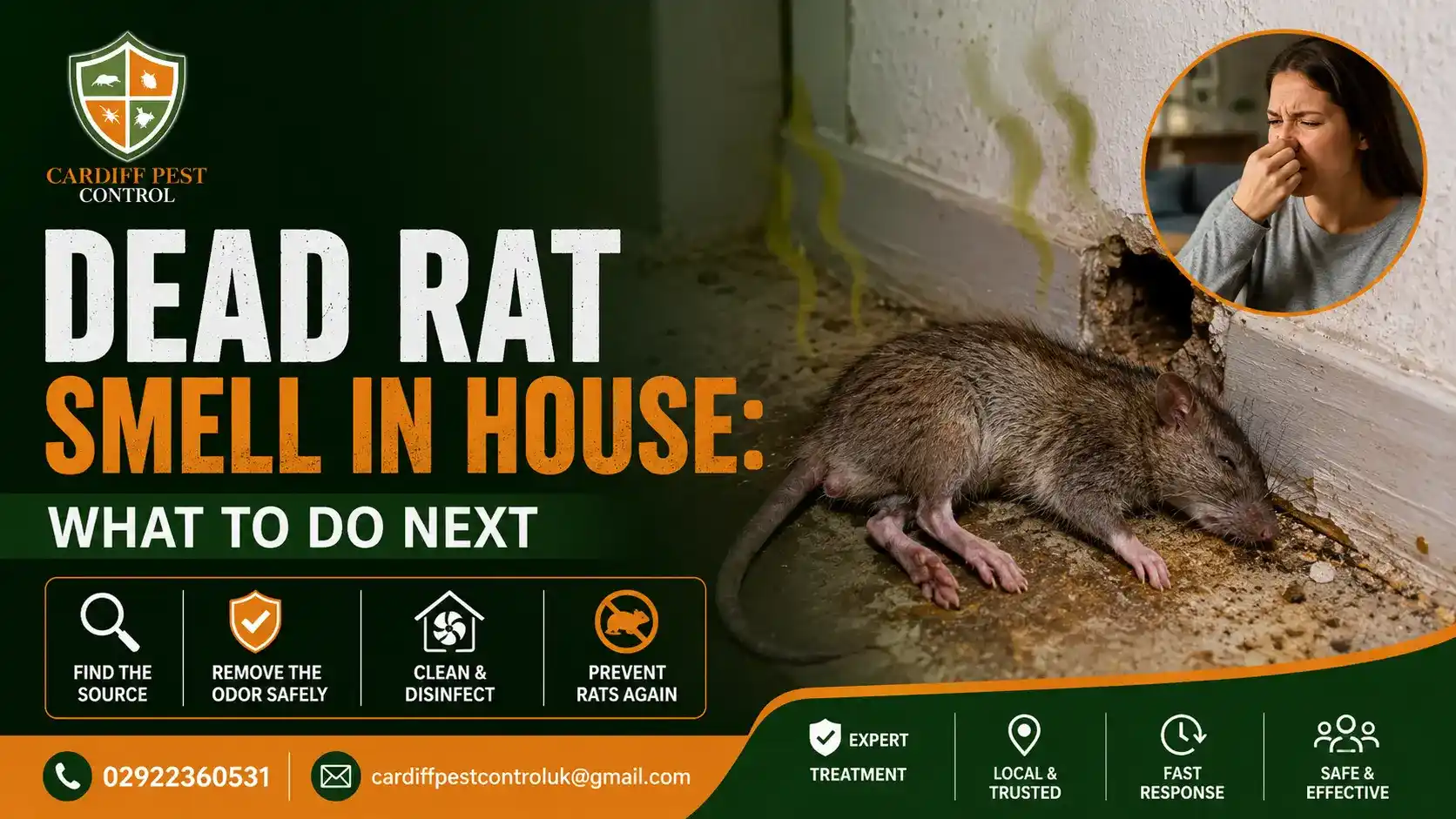
That horrible smell hit you out of nowhere. It’s thick, rotten, and getting stronger by the day. If you’ve got a dead rat smell in your house, you’re not alone, and you’re right to take it seriously.
A dead animal smell in your house can spread through walls, lofts, air vents, and floorboards within hours. It’s not just unpleasant. It can be a genuine health risk if left untreated. The longer you wait, the worse the foul smell in your house becomes, and the harder it is to remove.
This guide covers everything you need to know: how to identify the smell, how long it lasts, the health risks involved, the best removal methods, how to stop it from happening again, and when to call professional help. If you’re in South Wales, Cardiff Pest Control is here to help you deal with the dead rodent smell quickly and safely.
What Does a Dead Rat Smell Like?
Common Signs of a Dead Rodent Smell
The smell of a decomposing rat is hard to mistake. It hits you like a wave of rotting, sour, sulphurous odour, often described as a mix of rotten eggs, garbage, and wet soil. Here’s what to watch for:
- A strong rotten smell that wasn’t there before
- Odour that’s getting worse, not better
- Smell that’s strongest near one particular wall, ceiling, or room corner
- Decomposing rat smell that intensifies in warm weather
- A sweet-sour quality that turns your stomach
Dead Rat Smell vs Other Household Odours
Not every bad smell in your home is a dead rat. Here’s a quick comparison:
| Smell Type | Key Characteristics |
| Dead rat/rodent | Thick, sweet-sour, rotten, gets worse over days |
| Drain /sewer | Sulphur-based, usually near sinks or pipes |
| Damp or mould | Musty, earthy, consistent, often near walls |
| Food waste | Sour or sharp, usually near bins or the kitchen |
| Dead mouse smell in the wall | Similar to rat but slightly less intense |
If the smell is getting stronger and isn’t linked to drains, bins, or damp, you’re likely dealing with a rotten rat smell from a carcass somewhere in your property.
Why the Smell Gets Stronger Over Time
Rodent decomposition releases a cocktail of gases, including putrescine, cadaverine, and hydrogen sulphide. These are produced as bacteria break down soft tissue. The smell intensifies because:
- More gases are released as decomposition progresses
- Heat and humidity speed up bacterial growth
- Air circulation through vents pushes the odour through your home
- Wall cavity odour gets trapped and builds up
Why Does a Dead Rat Smell So Bad?
The Science Behind Rodent Decomposition
When a rat dies, its body begins breaking down almost immediately. Within 24–48 hours, bacteria inside the body start releasing gases. These gases are what create that unbearable decomposing animal odour.
As the process continues, soft tissues liquefy. Fats turn rancid. The smell is absorbed into nearby materials insulation, wood, plaster, and carpet. This is why a rat dying in a wall can leave an odour that lingers for weeks, even after the carcass is gone.
Where Dead Rats Are Commonly Found
Rats look for warm, dark, hidden spaces when they’re sick or dying. Common locations include:
- Lofts and attics especially near insulation
- Wall cavities almost impossible to reach without professional help
- Under floorboards particularly in older properties
- Air vents and ducting from where the smell circulates throughout the home
- False ceilings common in older Cardiff properties
- Behind kitchen units, boiler cupboards, or utility rooms
Learning the signs of rats in the house Cardiff residents experience can help you catch a problem before a rat dies in an inaccessible spot.
Why Warm Weather Makes the Odour Worse
Heat is the biggest enemy here. In warmer months, decomposing carcass odours can double in intensity within hours. Bacterial growth accelerates with temperature. A rat that might take three weeks to fully decompose in winter could break down in under ten days during a warm British summer. That’s why a dead rat in the ceiling can feel overwhelming in July but more manageable in January.
How Long Does a Dead Rat Smell Last in a House?
Quick Answer
A dead rat typically smells for 2 to 4 weeks. The smell peaks during the first week and gradually fades as the body desiccates. However, the odour can linger in soft furnishings, insulation, and wall cavities for months without proper cleaning and deodorising.
Average Timeline for a Dead Rat Smell
| Stage | Timeframe | What Happens |
| Early decomposition | Days 1–3 | Light smell begins |
| Peak odour | Days 4–10 | Strongest smell period |
| Active decay | Days 7–21 | The body decomposes rapidly |
| Drying out | Weeks 3–6 | Smell gradually reduces |
| Residual odour | Weeks to months | Smell in materials remains |
Smaller rats decompose faster. Larger rats take longer and produce more intense odour. A rat in a warm loft during summer will smell much more than one in a cold garage in winter.
Can the Smell Go Away on Its Own?
Technically, yes, eventually. But waiting is not a good idea. The longer you leave a dead animal smell in the loft or walls, the more the odour soaks into surrounding materials. You could end up needing to replace insulation or re-plaster walls. There’s also the risk of flies, maggots, and secondary pest problems. Knowing how to get rid of maggots becomes essential once fly larvae appear near a carcass.
Factors That Affect Odour Duration
- Temperature, higher heat = faster decay = stronger initial smell
- Humidity damp conditions slow drying but intensify bacterial odour
- Location enclosed spaces trap smell; open areas ventilate faster
- The size of the rat’s body = more material to decompose
- Contaminated insulation absorbs and holds odour long after the body is gone
Signs a Rat Has Died in Your Wall, Loft, or Floorboards
Smell Coming From One Area
If the dead rat smell in your house is noticeably stronger near one spot a kitchen wall, utility cupboard, or corner of a room that’s your best clue to the carcass location. Move along walls slowly, get close to skirting boards, and check near air vents or cable entry points.
Increased Fly or Insect Activity
One of the most reliable signs a rat has died somewhere in your home is a sudden increase in flies. Blow flies (the large, shiny, blue-green ones) are highly sensitive to decomposing matter and will gather near the source, even through walls. You may also notice:
- Clusters of flies on a single window or wall
- Maggots appearing near skirting boards or vents
- Carpet beetles or other scavenging insects near the same area
If flies are appearing indoors for no obvious reason, there’s almost certainly a trapped rodent decomposing nearby. Understanding the signs of rodent infestation can help you confirm this quickly.
Previous Rodent Activity Signs
If you’ve already noticed any of the following, a dead rat in the walls is a real possibility:
- Droppings near skirting boards, cupboards, or behind appliances
- Scratching or gnawing sounds at night (check our guide on rats in the walls)
- Gnaw marks on food packaging, cables, or woodwork
- Greasy rub marks along walls
Dead Rat Smell Coming Through Vents
If your central heating or ventilation system is circulating the odour, you likely have a dead rat in the ventilation ducting or somewhere near an air intake. The smell will seem to come from multiple rooms at once, which is confusing. This is a situation where professional help is often the fastest solution.
Can a Dead Rat’s Smell Make You Sick?
Health Risks Linked to Dead Rodents
Yes, a dead rat smell in your house is not just unpleasant. It can pose genuine health risks, particularly for children, elderly people, or anyone with respiratory conditions. Decomposing animal matter releases airborne bacteria and other pathogens into your home environment.
Diseases Associated With Rodents
Two diseases in particular are linked to rats and their remains:
Salmonella: Rats carry Salmonella bacteria in their gut and faeces. When a rat dies in a food preparation area or near ventilation, contamination risk increases significantly.
Leptospirosis: Also known as Weil’s disease, this bacterial infection is spread through rat urine but can also be present in decomposing tissue. It can cause flu-like symptoms that progress to liver and kidney damage in severe cases. The health dangers of rats in your home are well-documented and should be taken seriously.
Symptoms You Should Never Ignore
If you’ve been exposed to a dead rat smell in your house for several days, watch for:
- Persistent nausea or vomiting
- Headaches and dizziness
- Difficulty breathing or worsening asthma
- Skin rashes or unexplained irritation
- Fever after handling or cleaning near a carcass
Advice From the National Health Service
The National Health Service (NHS) recommends thorough sanitation cleaning after contact with rodent remains. Proper protective equipment, such as gloves, masks, and sealed bags, should always be used. Never handle dead rodents barehanded. Good ventilation during and after cleanup is also essential for property hygiene. See official NHS guidance on rodent-related illness for more details.
How to Find the Source of a Dead Rat Smell
Check Common Rodent Nesting Areas
Start your search in the places rats most commonly nest:
- Lofts check near water tanks, under insulation, and in corners
- Garages and outbuildings behind shelving and under floorboards
- Behind kitchen units, rats often nest next to warm pipes
- Boiler rooms and airing cupboards are warm and rarely disturbed
- Crawl spaces and subfloors, especially in older properties
Follow the Strongest Odour Path
Work your way around the affected area using your nose as a guide:
- Start in the room where the smell is strongest
- Move towards the walls and smell along the skirting boards
- Check air vents. Put your hand over them to feel the airflow direction
- Test wall corners and anywhere cables or pipes enter the wall
- Use a torch to check under appliances and inside cupboards
Signs the Rat Is Hidden Inside a Wall
If the rat is inside a wall cavity:
- The smell will be strongest at a specific point on the wall
- You may feel a slightly warm patch on the wall surface
- Fly activity will cluster near one area
- The smell won’t move or dissipate with ventilation
When Thermal Cameras or Professionals Are Needed
If you can’t locate the source after a thorough search, a professional pest inspection is the right call. Pest control experts use thermal imaging cameras to detect heat signatures from decomposing matter inside walls. This is far quicker and less destructive than opening up walls randomly.
Odour source detection is a specialist skill. Cardiff Pest Control has the tools and experience to locate hidden carcasses quickly and safely.
Best Ways to Remove Dead Rat Odour From Your House
Step 1: Remove the Carcass Safely
Before you do anything else, you need to get the body out. Safety first:
- Wear thick rubber or latex gloves
- Use an FFP2 or FFP3 face mask to avoid inhaling bacteria
- Double-bag the carcass in sealed plastic bags before disposal
- Never touch a dead rat with your bare hands
- Wash all clothing worn during removal immediately after
Step 2: Clean and Disinfect the Area Properly
Once the carcass is gone, thorough disinfection after dead rat removal is essential:
- Spray the area with a hospital-grade disinfectant or a bleach solution (1 part bleach to 10 parts water)
- Wipe down all surfaces the rat may have been in contact with
- If droppings are present, follow our guide on how to clean mouse droppings the same principles apply to rat droppings
- Dispose of any contaminated materials insulation, cardboard, nesting material in sealed bags
Step 3: Use Odour Absorbers and Ventilation
After sanitising, tackle the residual odour:
- Baking soda place open bowls around the affected area; it absorbs odour molecules naturally
- Activated charcoal highly effective at trapping airborne odour
- Air purifiers with HEPA filters remove airborne bacteria and particles
- Open windows and doors maximise airflow to flush out stale, contaminated air
- Enzyme cleaners specifically designed to break down organic odour compounds; far more effective than standard cleaners
Why Air Fresheners Alone Don’t Work
This is a critical point. Spraying air freshener, lighting candles, or using plug-in deodorisers will not remove a dead rat odour. They mask it temporarily. Within minutes, the underlying smell returns often stronger, as the two scents combine unpleasantly. Foul odour control requires removing the source and treating the affected area, not covering it up.
Professional Dead Rat Odour Removal Services
For serious cases particularly where the rat died in a wall, loft, or ventilation system professional treatment is the most reliable option. A professional service will:
- Locate and extract the carcass (including from inside walls if needed)
- Deep-sanitise contaminated areas
- Replace contaminated insulation if required
- Apply deodorising treatments that neutralise odour at a molecular level
- Conduct a full inspection for signs of further rodent activity
What Not to Do When You Smell a Dead Rat
Don’t Spray Strong Chemicals Blindly
Bleach, ammonia, and other strong chemicals used without locating the source are a waste of time. They can also be dangerous in enclosed spaces. Rodent odour removal requires targeted treatment, not random spraying.
Don’t Ignore the Smell for Weeks
The longer you wait, the worse the contamination. Flies will lay eggs, larvae will spread, and odour will penetrate deeper into building materials. What might be a one-day job for a professional becomes a major cleanup operation after three weeks.
Never Touch a Dead Rat Without Protection
Handling a decomposing carcass with bare hands is a serious hygiene risk. Leptospirosis, Salmonella, and other pathogens can be transmitted through direct contact or via mucous membranes. Always use full protective gear.
Why Bleach Alone Is Not Enough
Bleach is an effective disinfectant, but it does not neutralise odour compounds. It kills bacteria on contact but won’t penetrate deep into wood, plaster, or insulation where odour molecules have already absorbed. Dead animal odour removal requires enzyme-based treatments as well as disinfection.
When to Call Professional Pest Control in Cardiff
Signs You Need Emergency Rodent Removal
Some situations call for immediate professional help:
- The smell has been present for more than 3–4 days with no obvious source
- The smell is getting stronger despite ventilation
- You can hear no scratching but the smell suggests multiple animals
- Flies are appearing indoors in large numbers
- You’ve found the location but can’t safely access it (inside walls, roof joists)
- You suspect a dead rat infestation or multiple carcasses
Benefits of Hiring Cardiff Pest Control
Cardiff Pest Control provides a fast, thorough response to dead rat removal across Cardiff and the surrounding areas. The benefits of hiring a professional include:
- Rapid identification of the carcass location using specialist equipment
- Safe extraction without damaging your walls or ceilings unnecessarily
- Full sanitisation and deodorising treatment
- Inspection for rodent entry points to prevent re-entry
- Clear advice on pest prevention going forward
- Full compliance with UK pest control regulations and official BPCA guidelines
What a Professional Visit Includes
A typical professional visit from Cardiff Pest Control will cover:
- Inspection of a full property survey to locate all signs of rodent activity
- Carcass removal, safe extraction with full protective equipment
- Sanitation disinfection of affected areas
- Deodorising professional-grade odour neutralisers applied to surfaces and voids
- Rodent proofing, identification and sealing of entry points
- Prevention advice tailored to your property type and situation
If you’ve been dealing with ongoing rodent activity, a professional pest control service gives you peace of mind that the problem is dealt with properly, not just temporarily masked.
How to Prevent Dead Rat Smells and Future Rodent Problems
Seal Rodent Entry Points
Rats can squeeze through gaps as small as 20mm. Check and seal:
- Gaps around pipes and cables where they enter walls
- Cracks in brickwork or render
- Gaps under doors (use rubber draught excluders)
- Damaged air bricks or vents (replace with mesh-covered alternatives)
- Spaces around loft hatches
Store Food Correctly
Rats are opportunistic feeders. Remove easy food sources:
- Store dry goods in sealed metal or hard plastic containers
- Never leave pet food out overnight
- Keep bin lids firmly closed
- Clear fallen fruit from gardens promptly
Remove Outdoor Attractions
Your garden can invite rats in before they ever reach your home:
- Clear dense undergrowth and overgrown borders
- Remove garden waste and compost heaps that aren’t properly managed
- Don’t leave bird seed scattered on the ground
- Keep sheds and outbuildings tidy and clutter-free
Schedule Regular Pest Inspections
The most effective way to avoid a dead rat smell in your house is to catch a rat infestation before any animals die in inaccessible spots. Why regular pest inspections are important cannot be overstated. A professional can identify rodent activity before you’d notice it yourself.
Keep Loft and Storage Areas Clean
Rats love undisturbed, cluttered spaces. Regularly check and clear the lofts, garages, and the under-stairs storage. Avoiding top loft clearance mistakes means rats have fewer places to nest undiscovered. The top health and hygiene risks associated with rodents are vastly reduced when properties are well-maintained and regularly inspected.
Final Thoughts on Dead Rat Smell in House
A dead rat smell in your house is more than an inconvenience. It’s a signal that something needs to be done quickly and correctly.
The key takeaways from this guide:
- The smell is caused by rodent decomposition, releasing gases and bacteria
- It can last 2–6 weeks and longer if not properly treated
- Health risks include Salmonella, Leptospirosis, and respiratory irritation
- Always use protective equipment when handling a dead rodent
- Air fresheners don’t fix the problem; proper disinfection and odour neutralisers do
- Prevention through sealing entry points and regular inspections is the best long-term strategy
If you’re struggling with a dead rat smell or any signs of rodent infestation in Cardiff or nearby areas, don’t wait for it to get worse. Cardiff Pest Control provides professional, discreet, and fast rodent removal, sanitation, and pest prevention services across the region. Get in touch today and let the experts deal with it properly.
Frequently Asked Questions About Dead Rat Smell in House
1. How long does a dead rat smell last in a house?
Typically, between 2 and 4 weeks from the point of death. The smell peaks in the first week and gradually reduces as the body desiccates. However, without proper cleaning, residual odour can linger for months in insulation, wood, and soft furnishings.
2. Can a dead rat’s smell make you sick?
Yes. Airborne bacteria released during decomposition can irritate the respiratory system. Closer contact, such as cleaning without protection, carries the risk of exposure to Salmonella, Leptospirosis, and other pathogens linked to rodents.
3. What does a dead rat smell like?
It’s a thick, sweet-sour, intensely rotten smell. Many describe it as a mix of rotting eggs, overripe fruit, and decomposing meat. It is very distinct from mould, drains, or food waste smells.
4. How do I find a dead rat in my wall?
Follow the strongest odour along skirting boards and walls. Look for clustering flies or maggot activity. Feel for warm patches on wall surfaces. If you can’t locate it yourself, a professional with thermal imaging equipment can identify the exact location quickly.
5. Will the smell of a dead rat go away naturally?
Eventually, yes, but it can take many weeks, and the odour will absorb deeply into surrounding materials in the meantime. Waiting also increases the risk of fly infestations and secondary pest problems.
6. What removes dead rat smell fast?
The fastest solution is: remove the carcass, disinfect the area with a bleach-based solution, apply an enzyme cleaner, then use activated charcoal or baking soda for ongoing odour absorption. Maximise ventilation throughout.
7. Does bleach remove dead rat odour?
Bleach disinfects bacteria but does not neutralise odour compounds. It’s an important part of the process, but must be combined with enzyme-based odour neutralisers for effective results.
8. Can a dead rat smell spread through vents?
Absolutely. If the rat died near or inside a ventilation system, the smell will circulate through every room served by that system. This is one of the most challenging scenarios and often requires professional rodent odour removal.
9. Why does my house smell like something died?
If the smell is strong, sweet-sour, and getting worse rather than better, there’s a very good chance a rodent has died somewhere in your property, likely inside a wall, under floorboards, or in the loft. Check for the signs of rats in house Cardiff homeowners most commonly report.
10. How much does dead rat removal cost in the UK?
Costs vary depending on how accessible the carcass is. A straightforward removal from an accessible area may cost £75–£150. If walls need to be opened or specialist equipment is needed, costs are higher. Most pest control companies offer a free inspection call to assess the situation first.
11. Do dead rats attract flies and insects?
Yes. Blow flies, carpet beetles, and other scavenging insects are strongly attracted to decomposing matter. If you’re suddenly seeing large flies indoors, it’s a strong indicator that something has died nearby. You may also need to know how to get rid of cluster flies if the problem persists after removal.
12. Is a dead mouse smell different from a dead rat smell?
They’re very similar in character, but a dead mouse smell in a wall is typically less intense due to the smaller body mass. A dead rat produces significantly more gases, and the smell is noticeably stronger and longer-lasting.
13. Can pest control remove dead rats from walls?
Yes. Professional pest controllers have specialist equipment to locate rats inside wall cavities and can remove them with minimal structural damage. In many cases, a small access point is created, the carcass extracted, and the area sealed and treated.
14. What absorbs dead animal smell naturally?
Activated charcoal is the most effective natural odour absorber. Baking soda also works well. White vinegar placed in open bowls can help neutralise odour molecules. These should be used after the carcass has been removed and the area disinfected, not as a substitute for removal.
15. How can I stop rats from returning to my house?
Seal all gaps and entry points, remove food sources, keep your loft and storage areas clear, and schedule regular pest control inspections. If you’ve had one rat die in your home, there’s a good chance others are present. A professional inspection from Cardiff Pest Control will identify whether you have an ongoing rodent infestation and advise on the right long-term prevention strategy.