
Table of Contents
ToggleFinding a trail of small, dark pellets in your kitchen cupboards or under the sink is a moment of pure dread for most of us. It isn’t just about the mess; it’s the immediate realization that you are sharing your home with rodents. At Cardiff Pest Control, we understand that your first instinct is to grab a brush and sweep them away. However, doing that could actually put your health at risk.
Cleaning up after rodents is a serious task that requires a specific approach. In this guide, we are going to explain how to clean mouse droppings without putting yourself in danger, how to tell the difference between mouse vs rat droppings, and what the actual chances of getting sick from mouse droppings are in a typical Cardiff home.
What Do Mouse Droppings Look Like?
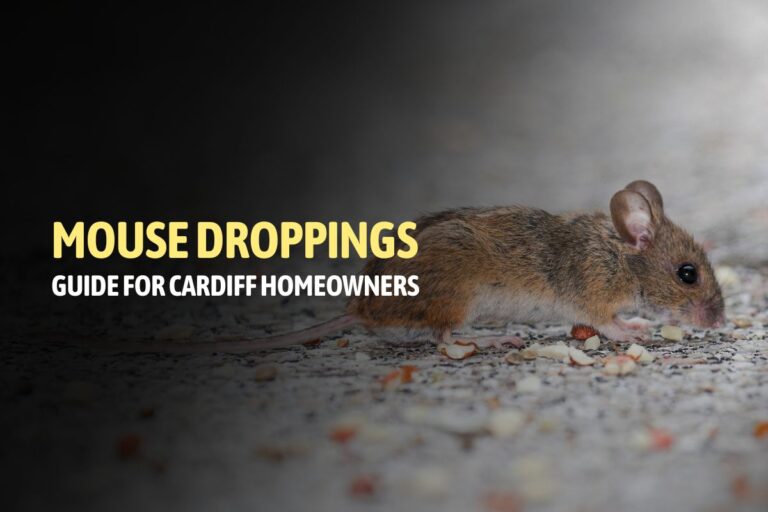
Before you start cleaning, you need to be sure what you are dealing with. If you are asking what do mouse droppings look like, think of a small grain of black rice.
Here are the specific features to look for:
- Size: They are usually between 3mm and 6mm long.
- Shape: They have pointed ends and a spindle-like shape.
- Color: Fresh droppings are dark brown or black and have a slightly moist, “putty-like” texture. Older droppings turn grey, dry out, and become brittle, crumbling easily when touched.
- Quantity: A single mouse can produce 50 to 80 droppings in one night, so you will often find them in clusters rather than just one or two.
If you find something larger or with rounded ends, you might be dealing with a different rodent. For more help with identification, you can read our guide on the signs of rats in house (Cardiff edition).
Mouse vs Rat Droppings: Knowing the Difference
It is critical to know the difference between mouse vs rat droppings because the scale of the problem—and the treatment needed—is very different.
While they look similar in shape, the size is the dead giveaway.
- Mouse droppings are about the size of a grain of rice (3–6mm).
- Rat droppings are much larger, usually around 12mm to 20mm long (about the size of an olive stone). They also tend to have more rounded or blunt ends compared to the sharp points of a mouse’s waste.
Whether it is a mouse vs rat droppings situation, both signify a breach in your home’s defenses. If you see the larger rat-sized pellets, the level of urgency increases significantly as rats can cause more structural damage in a shorter time.
Illness from Mouse Droppings: The Risks
We don’t want to cause unnecessary panic, but we have to be honest about the risks. Illness from mouse droppings is a real concern because rodents are carriers of several pathogens.
When people ask about the chances of getting sick from mouse droppings, the answer depends on how you handle them. The biggest risk comes from “aerosolization.” This happens when you sweep or vacuum dry droppings, kicking dust and viral particles into the air where you can breathe them in.
Some of the primary health concerns include:
- Hantavirus: This is a severe respiratory disease. It is spread through the urine, droppings, and saliva of infected rodents.
- Salmonellosis: If mice track across your food prep surfaces, they can leave behind Salmonella bacteria, leading to food poisoning.
- Leptospirosis: This is often spread through contact with rodent urine but can be present in contaminated areas.
- Lymphocytic Choriomeningitis (LCMV): A viral infection that can cause serious issues, especially for those with weakened immune systems.
How Long Are Mouse Droppings Dangerous?
Another common question we get is: how long are mouse droppings dangerous? Unfortunately, there is no simple timer. While some viruses, like Hantavirus, may only survive for a few days outside a host, bacteria like Salmonella can persist much longer in the right conditions.
Even if the virus has died, the droppings are still a sign of an active or recent infestation. As long as the droppings are there, they can attract other pests and signal to other mice that your home is a safe place to feed. We always treat any dropping as a live biohazard, regardless of how old it looks.
Step-by-Step: How to Clean Mouse Droppings Safely
If you have decided to handle the cleanup yourself, you must follow these safety steps. At Cardiff Pest Control, we use professional-grade PPE, and we suggest you do the same.
1. Preparation and Ventilation
Before you start, open the windows and doors in the area for at least 30 minutes to let fresh air circulate. Do not stay in the room while it is venting. This helps clear out any airborne particles.
2. Personal Protective Equipment (PPE)
Do not touch anything with your bare hands. You will need:
- Rubber, vinyl, or latex gloves.
- A well-fitting mask (an N95 or FFP3 respirator is best).
- Eye protection if you are cleaning in a confined space like a loft.
3. The “Wet” Method (No Vacuuming!)
Never sweep or vacuum mouse droppings. This is the most important rule. Instead, use a “wet” method:
- Spray the droppings and the surrounding area with a disinfectant or a mix of 1 part bleach to 10 parts water.
- Let it soak for at least 5 minutes. This kills the pathogens and keeps the dust from rising.
- Use a paper towel to pick up the soaked droppings and put them in a plastic bag.
4. Deep Cleaning the Surfaces
Once the droppings are gone, you need to disinfect the entire area. Mop floors and wipe down counters with your bleach solution or a strong disinfectant. If you have found droppings on carpets or upholstery, these should be steam-cleaned professionally.
5. Proper Disposal
Seal the plastic bag tightly and put it into an outside bin. Take off your gloves and wash your hands thoroughly with soap and warm water immediately.
Why You Need a Professional Survey
Cleaning the mess is only half the battle. If you don’t find out how they got in, you will be cleaning up more droppings next week. Mice can squeeze through a gap the size of a ballpoint pen.
When we carry out rodent control in Cardiff, we don’t just clear the current population. We look for the entry points—gaps in brickwork, holes around pipes, or faulty air bricks—and seal them. We use professional tracking dust and infrared cameras to find exactly where they are hiding.
If you are feeling overwhelmed by a rodent issue, the best step is to contact us for a full property inspection. We can take the stress out of the situation and ensure your home is safe and sanitary again.
FAQs
Can I get sick just by being in the same room as mouse droppings?
The risk is low if the droppings are undisturbed. The danger increases significantly if you stir up dust by sweeping, vacuuming, or moving boxes that have droppings on them. Always wear a mask if you suspect an infestation in a confined space like an attic or basement.
What does a mouse dropping look like compared to a bat’s?
This is a common mix-up in Cardiff. Bat droppings look very similar to mouse droppings but are very brittle. If you crush a bat dropping (using a tool, not your fingers!), it will crumble into shiny metallic-looking bits of insect wings. Mouse droppings do not do this.
I found droppings in my toaster. What should I do?
We strongly recommend throwing the toaster away. Mice carry many bacteria, and it is almost impossible to fully disinfect the internal heating elements of a toaster. The risk of food poisoning isn’t worth the cost of a new appliance.
Should I use a steam cleaner on my carpets?
Yes, steam cleaning is an excellent way to kill bacteria and viruses in carpets after you have removed the physical droppings using the “wet” method. The high heat effectively sanitizes the fibers where sprays might not reach.
Why are there so many droppings in one spot?
Mice tend to use the same “pathways” every night. They often leave droppings where they stop to eat or where they feel safe, such as behind appliances or in the corners of cupboards. These “latrine” areas are a clear indicator of where to place traps
Can my dog or cat get sick from mouse droppings?
Yes, pets can contract diseases like Leptospirosis or Toxoplasmosis from contact with rodent waste or by catching an infected mouse. Keep your pets away from any areas where you have found signs of rodents until the area has been fully cleaned.